Alan Machin: Tourism As Education
Click here for the Leeds Met Tourism Alumni page
Work on a book about educational aspects of tourism has prevented me addding new postings for a while. This is changing!


The Dursley Pedersen Bicycle
Danish inventor Mikael Pedersen worked for the Dursley engineering company R A Lister late in the nineteenth century. Lister was famous as a maker of diesel engines. Pedersen invented a different kind of bicycle with a ‘hammock’ seat and an unusual frame. Lister entered into an arrangement with him to manufacture the bikes. Though at first successful, by 1917 the sales ceased. Three years later, Pedersen returned to Denmark where he later died.
A group of cycling enthusiasts kept the knowledge of the Pedersen bicycle alive. Even in Denmark, the inventor was largely unknown. Then, in 1995, cycling groups raised the money to bring Pedersen’s remains back to Britain and he now lies buried in Dursley Cemetery. The house where he once lived is shown above with its commemorative plaque. A Pedersen bike hangs on display in the town’s Heritage Centre. In St James’s Church near to both his home and the Heritage display there is a modern mosaic about the town, with another depiction of the bike that made Dursley famous among cyclists in the Edwardian era.
The interpretation panel with his story is one of four about the town that have been placed on the side of Sainsbury's supermarket near the church. The town tells its stories to tourists very effectively! (The blotchy shape in front is a bit of decorative shrub courtesy of Sainsbury's).
[13.05.13]
-oOo-

Painswick Rococo Garden
Close to Gloucester but perched on the edge of the Cotswolds, Painswick is a very attractive place. The Georgian, and earlier, buildings are of local Cotswold stone, pale grey-cream in colour but weathered by the centuries.
The Rococo Garden lies in a small coombe or valley nearby. Benjamin Hyett began the garden in the 1740s. It formed part of his property of Painswick House. There were other sections to his estate and this was to be a pleasure garden full of trees, shrubs, flowers and small architectural features. His family and friends could walk around, finding something of interest in every view. The ladies who visited might take afternoon tea in one of the little pavilions. Vegetables for the kitchen were also grown by Hyett’s men, yet the planted rows formed part of the interest themselves. The word Rococo refers to the style of architecture in the pavilions and structures dotted around. They maintain their slightly florid shapes and asymmetrical designs, popular in Benjamin Hyett’s day.
A Trust now cares for the Garden, open to the public to wander round. The house is privately owned, and not open.
[13.05 .13]
-oOo-

The Severn and Wye Smokery
The weather threatening rain, we went yesterday (11.05.13) to this smokehouse and food shop. It is in Chaxhill, near Westbury-on-Severn.
If a food shop is good, then looking around reveals all sorts of interesting foods and brands. Like many of its kind, the Severn and Wye aims to support local suppliers while also bringing in good produce from further away. There were some from Europe and at least one from New Zealand - green mussels. The fish counter carried all sorts of fish, crabs, oysters - and eels. Freshly baked bread, cheeses, meat and vegetables were available. Wine, beers and some excellent cider were on sale. We had flash-fried eel in a mustard sauce with mash and rocket. Delish!
As a smokery, the company prepares in its own smokehouse a range of produce for the shop and other retailers. Their brochure and web site list Selfridges, Harvey Nichols and Fortnum and Mason amongst its clients. Internal windows let shoppers look into the two main preparation areas. These were busy yesterday - unusually as it was Saturday - but apparently an important order was needing some extra work.
They also are keen to help redevelop the eel fishing industry along these rivers. Young eels - elvers - are bred, some for the shop and others for the rivers. The S&WS people have sent elvers to local schools for the chiildren to study and grow before putting them into the river system again. The young eels swim down the Severn Estuary and cross the Atlantic into the Sargasso Sea before returning to breed on this side of the ocean.
But there are some signs of local disquiet about the business. There have been complaints about developments happening without planning permission having been obtained first. Reports have circulated about the S&WS seeking retrospective permissions. Others complained about smells and litter. We found neither on our visit, but successful tourist businesses cannot afford to create bad relations any more than any other kind of enterprise. Part of the problem is that expansion has meant too much sewage and waste is now being produced. In April this year, a plan for a new water treatment lagoon was rejected by the local Council, who felt they were faced with a business gowing fast in a location only suited for something small. The Smokery is alongside the A48 in open country, not a built-up area. It employs, as we saw, a large workforce, so as ever, in an economic downturn a successful business is a valuable asset. The problem will doubtless be solved somehow.
[12.05.13]

The Delights of Caravan Sites on Farms
We love 'em. This month (May, 2013) we stayed on one near Dursley, in Gloucestershire, and another close to Plympton, Devon. The Caravan Club has what it calls 'certificated list' sites, or 'CLs', which can have no more than five 'vans at a time. They're most often on farms where they bring some extra income.
The farmer owning the Dursley land concentrates on sheep, while renting out some arable land to another farmer nearby. We watched over two days as the field seen in the photos was harrowed and sown with maize. When we stayed here a couple of years ago, one summer, there was a crop of maize ripening. The wet weather has delayed many farms' sowing and planting, while more recent dry weather has meant that grass has been slow to grow. As a pair of townies, now retired, it's good to talk to the farmers about their rural lives. We have found them all to be friendly and willing to explain their work
-oOo-

The Gloucester and Sharpness Canal
Gloucester was once a busy port with docks and warehouses. Barges sailed up the tricky Severn Estuary to Sharpness where they entered a canal through locks. The canal was a much safer navigation than the river with its high tidal range. Some high tides cause the famous Severn surge-wave or 'bore' which rushes upstream.
Sharpness still has commercial traffic at its docks. The canal is now used for leisure, passing as it does through beautiful countryside.
-oOo-

Toposcopes
An early form of information panel describing landscape views was the toposcope. Quite a few are still to be found. An early version was used in a window frame by Peter Crosthwaite at his museum in the Lake District in the seventeenth century. The one above was installed on a masonry pillar by the Automobile Association. Lines engraved on the metal disc lead the eye to distant landmarks with their names shown. It stands on Coaley Peak near Dursley, Gloucestershire.
Not far away from it is another panel, seen here top right. Made of a tough resin, it encapsulates a colourful sketch of the same view with places labelled. These are often called interpretation panels. They don't just label things, but try to explanation features.
-oOo-

Click here to read the presentation
An Important New Presentation:
Following the success of the Cuba presentation: "Back to Basics"
Making Sense
Examining the theory and practice of Tourism as Education
The first of three extended pages
.
-oOo-
.


Little Shop, Big on Cheese
We took a trip to Cleatop, just south of Settle. The Courtyard Dairy is part of a new retail and restaurant complex. Andy and Kathy Swinscoe choose a range of the best cheeses from the UK, France and other European countries for their shop.
The day was overcast with low cloud sitting on the tops of the Pennines. Only near to Skipton was the sun out as we drove the A65. Cleatop is hardly more than a farm plus the new Courtyard project. As it lies in the Yorkshire Dales National Park, signposting is carefully controlled. We knew about the place before we set out. If you didn’t, it would be easy to drive past as the road is quite fast and twists about. It only opened in 2012 and Google Earth Street View doesn’t yet show it. Images on Street View were made before restoration and conversion began.
One hint that there is something going on is the car park, which looked busy. But there was plenty of space. It is quite a compact development overall. Some time ago, the A65 was downgraded from a trunk road to a standard ‘A’ road. This allowed planning permission to be given for the Courtyard project, since the road entrance would have been judged too busy in terms of traffic when it was a trunk route. Presumably, the mix has become lighter as regards lorries, even though the car traffic might be increasing.
A plan showing the shops and restaurant is prominent inside the gateway. A small building to the right is labelled as the Brasserie Shop, and it’s listed in the publicity leaflet we picked up later, but it isn’t yet open. It will sell refreshments for taking away or eating at tables already set out in the yard. Whether they would object to visitors eating their own packed lunches there wasn’t clear. Until it is open, the leaflet is misleading.
Andy was at work in his shop, the first one on the left. He has a sandwich board outside advertising a particular cheese on offer, but his cheerful ‘hello’ is enough to entice people in. It’s a very small shop. The Courtyard opened in May, 2012, but Andy and Kathy moved in only last December. Other shopkeepers generally need something much bigger. For keeping specialist cheeses, it’s ideal – thick walls, one tiny window, one door – just right for controlling the conditions. On the other hand, it was noticeable that as we spent time talking about his work, most people spent only a few moments inside before moving on. Newcomers might well feel they’re intruding into a private conversation in that small space. Of course, some people might have looked around other shops and returned later.
Pat is the cook, so while she talked shop, I took photographs. Mind you, I missed none of the slivers of delicious cheese that Andy cut fresh from each block as samples. And Pat took photographs, some of which are shown here.

Andy Swinscoe is in his late twenties. He hails from Cumbria but worked in several restaurants including the Balmoral Hotel’s Michelin-starred dining room in Edinburgh. He found his fascination with cheeses early on. After taking a first-class degree in Culinary Arts and Hospitality at Sheffield Hallam, he worked for a while for Paxton and Whitfield in London. Part of his job there was to deliver cheeses to some of their top clients, including those at Buckingham Palace. He gained an award from the Queen Elizabeth Scholarship Trust that allowed him to become an apprentice in affinage, the highly skilled art of ageing cheeses. His teacher was Hervé Mons, thought by many to be the best affineur in the world.
After time in France, Andy returned to a job with the Fine Cheese Company. This took him to many producers and retailers in the UK and abroad. Then last year, he and his partner Kathy opened the Courtyard Dairy, the outcome of a long-held dream to become a seller of the finest cheeses available. And there those cheeses are, made from cow’s, goat’s and sheep’s milk, soft and creamy or hard, with smells and spicy tastes adding to their variety.
Andy believes that every cheese is unique unless it is made from milk blended from different sources. He talks about terroir in the way that a wine-maker does – the way that cheeses, like grapes, owe their characteristics to the places they were made. It’s a combination of physical geography, the type of soil, the plants that feed the animals (or the vines), the climate and the skill of the producers. We heard similar views from beekeepers last year at the Halifax Agricultural Show. They offered tastes of honey made from bees feeding on flower combinations only a mile or two part – and even we could detect subtle variations. Andy talked of his time as an apprentice. He had met a French farmer who had collected over a hundred different kinds of hay. This man could differentiate them all by their smell, thanks to their different terroirs.
Pat chose a selection of cheeses and a chorizo from the shop’s charcuterie. The meats hung from hooks above another prized piece of gear, a traditional hand-powered meat slicer that could cut accurate slices of many required thicknesses. Perhaps it was a result of the small size of the shop that it also made a perch for their credit-card terminal that day.
One of the other shops was that of a wine specialist. It was another important factor in choosing to set up the cheese shop up in the Courtyard. We chose a bottle for our own cheese and wine evening later. And for our lunch we went to the Brasserie, where we had possibly the best seafood chowder ever (take note, American family and friends). The Courtyard is a fine addition to the Dales’ attractiveness, smart and well designed, with its furniture, clothing and gift specialists. They do all aim upmarket, which is in line with many of the people visiting the Yorkshire Dales. For good cheeses and wines, there is much to be found there, and long may they, and the other shops, prosper.
[8.01.13]


The Oldest Sweetshop in England
We made a day out in the Yorkshire Dales in early December. Pateley Bridge is in North Yorkshire. The oldest sweetshop featured in Nigel Slater's programme "Life is Sweets" on BBC TV. A walk up the main street took us to the shop. Though we had been near it before, it was the first time we went in. We had missed a little treasure before - nostalgic, yes, but also a good place to buy presents for Christmas (or any other occasion).
________________________________________________
.
Sausages
An ancient joke tells of a woman going into a butcher’s shop in a time of economic gloom. She complains about the sausages she bought there yesterday. “Too much bread in one end of each”, she says. “Sorry, madam” he replies, “these days it’s hard to make both ends meat”.
I’m not sure if that joke even works with anyone aged below 30. But it does remind us about trying to make good products with poor resources.
The more I hear about universities, the more I think of sausage machines. Raw material – students, lecturers, information – goes in at one end, the machinery grinds and whirrs and lots of sausages come out at the other end. The factory making them is under pressure to increase production but is supplied with fewer resources. It must scrape up whatever it can. The managers were recruited in a hurry to operate the system. Those who know how to make good sausages are outnumbered by those without a clue. Some of the clueless couldn’t care less about sausages but just want to become famous multinational managers. The factory public relations people help them do it. Quality control becomes a joke. Short cuts are taken to ensure target quantities are delivered.
And without the means, the ends can all too often fall short of what everyone wants.
[05.12.12]

Flatland

Beverley Minster
On the south side of Beverley is the famous Minster. It was founded by Saint John of Beverley who had been Bishop of Hexham and then Bishop of York. John founded a monastery here around 700AD. When he died twenty-one years later, he was buried at the spot marked by the memorial plaque shown above. The church here went through phases of rebuilding. It had a central tower like St Mary’s Church (posting below) which went through a similar catastrophic collapse around 1213. Rebuilding took two centuries of work, but resulted in what some call one of the most magnificent parish churches of England and a Gothic masterpiece.
Pilgrims made their way to St John’s tomb at Beverley. The statue of him stands inside the South Door, close to the Norman font of 1070, a survivor possibly of one of the earlier churches on this site. It was carved of ‘marble’ from Frosterley in County Durham – not actually marble, but polished limestone often referred to as marble. The font was made only four years of the Battle of Hastings that brought Norman rule to England. Above the font hangs an elaborate font cover of the eighteenth century.

St Mary’s Church, Beverley Beverley is a historic town just north of Hull. It is in the flat country extending inland from the coast, though technically not part of Holderness, which lies to the east of the River Hull. We made two visits to see the market square, the Minster and St Mary’s Church – and, on one of days, to have lunch at the Green Dragon Hotel on the former market square. St Mary’s is not as large as the Minster, but still imposing, with much detail waiting to be explored. The Virgin Mary is shown holding the infant Jesus. The skull carving is a common church feature, a reminder to congregations and visitors of the transient nature of human existence. Outside the South Door are medieval images (eg lower left photo) intended to frighten off evil spirits, a reminder of the superstitious basis of much belief in those years. Rather more realistic was the series of carved heads, of which one is shown here (top, centre). In 1520, the old tower collapsed, killing many who were in the church for a service. It was rebuilt, with the principle fund-givers commemorated by having their heads shown in stone carvings like this one. Top left is a benevolent-looking sheep’s head to the left of a doorway inside the Church. Opposite it is a famous carving of a rabbit. It is said to have been the inspiration for the White Rabbit in Alice in Wonderland by Lewis Carroll.

St Patrick’s Church, Patrington
A touch of architectural pride from older days labelled this church ‘The Queen of Holderness’. The church guidebook claims it is “universally recognised as one of the most beautiful parish churches in England” which sounds like Jane Austen popped in two centuries ago. But yes, it is beautiful, even handsome, if queens are ever to be given that description. The 189-foot spire points to the heavens and attracts travellers from across Holderness into the church. Its reputation draws tourists from much further afield, as it did ourselves, on our second or third visit. St Patrick’s may look over-special for this landscape of villages and hamlets, but Holderness was once much larger. Sea erosion has destroyed many ancient towns that would have traded in Patrington’s weekly markets and worshipped in its church. After 1717, the church was under the patronage of no less than Clare College, Cambridge. It was built in the late 13th to mid 14th centuries. The font dates from those times; the pulpit is from 1612 and the reredos (the wall decoration behind the altar) was added in 1936. In the bell loft are bells dated from 1674, 1846, 1888 and 1948. In the last-named year, two bells were added to commemorate those killed in World War II.
King George V was Lord of the Manor of Patrington. He died in 1935. At that time, the Rector of St Patrick’s was Percival Ryder Frost, and he was the principal donor towards the commissioned work. Glimpsed through the finely carved rood screen that separates the nave from the chancel, the reredos is an eye-catching addition to the church’s iconography. At the centre of the row of figures is the Virgin Mary. To either side are the twelve saints associated with Northumbria, of which Holderness was a part in the early Middle Ages when the Northumbria extended across the whole of present-day northern England. Saints Columba, Aidan, Cuthbert and the Venerable Bede are among them. So, too, is St Hilda, founding abbess of the monastery at Whitby. She holds a model of the Abbey Church.

Good Range of Visitor Communication
The Deep has a good range of visitor communication. Most of it is by graphic panels next to the tanks or other exhibits. Much use is made of video and sound. At intervals along the winding ramp into the main display, areas are installations telling an evolutionary story. Above video screens are hung plastic domes holding special loudspeakers (bottom, left photo). The audio commentary and sounds from these is reflected down at visitors standing close to the screens. It helps prevent the distractions of adjacent commentaries clashing with each other, a problem often found in exhibitions using a lot of A/V equipment. Sound is always a bigger problem for gallery designers than vision – as it is throughout the entertainment industry.

... With a Full Supporting Cast
“There are plenty of fish in the sea” goes the saying, and plenty in the tanks of The Deep. Several smaller aquariums hold particular species for a closer inspection. There are also some highly colourful frogs and complex-patterned corals. This is show business - and so it should be!

Lessons in How to Feed a Shark
The main tank at The Deep descends through 30 metres of the exhibition floors of the building. Visitors start on a high floor and walk down curving gallery ramps as if they are entering an ocean. One of the best places to see the sharks and rays is when they are fed and checked over by divers at about 2:00pm each day. A drop-screen is lowered to show a CCTV image of the divers preparing and donning their equipment and a member of staff gives a commentary. The sound quality over a loudspeaker system was not ideal. The speaker we heard spoke too quickly, using a normal pace and rhythm, which did not allow for the acoustics of the rather environment. The sound included a lot of ‘popping’ either from the mike being too close to the user’s mouth, or from an overloaded auto-level loudness control. Announcements said the feeding would begin at 2pm, but the actual time the staff entered the water was probably fifteen minutes later. Younger and older members of the audience were getting fidgety. Despite those more minor problems, the diving was worth the wait. The animals are not only fed, but also checked for health and sometimes will be given individual medical care.

The Deep
We had been to Hull’s ‘Submarium’ soon after it opened in 2002. Having enjoyed that visit, we looked forward to a second trip. It was also going to be useful because, having lacked web connection in Great Hatfield and even Beverley; we guessed that the Hull location should do better. And it was. About an hour got us through most online jobs.
The Submarium means, presumably, a deep aquarium where you can descend on ramps or lift through the full height, with an underwater tunnel at the base. I imagine other aquariums would claim something similar, though, including the National Aquarium in Plymouth. The main tank is 30 metres deep and holds two and a half million litres of water. Besides seven species of shark, there are rays and other fishes, sea horses, frogs, plants and corals. This aquarium is run by a charitable trust, not a commercial company as some other centres are. It was built with half of its £52m initial cost having come from the Millennium Commission with the rest from different sources. Income is from ticket sales, membership fees and retail sales. The building was designed by Sir Terry Farrell. Outside, a sculpture of a shark symbolises the attraction which looks out across the Humber Estuary with the River Hull flowing under the towers of the tidal barrier to join the muddy flow.
<< Read more postings on 'Flatland' in the page listed top left.

Above:
Two slides from the lecture given in November 2010 in Havana at the CETA Conference.
Click here to read the full conference presentation


Click here to see the above page 'Talking to Tourists'


Click here to read about the HE Teaching Spectrum - scroll down the page found


Click here to see the above page: 'A Richer Earth'


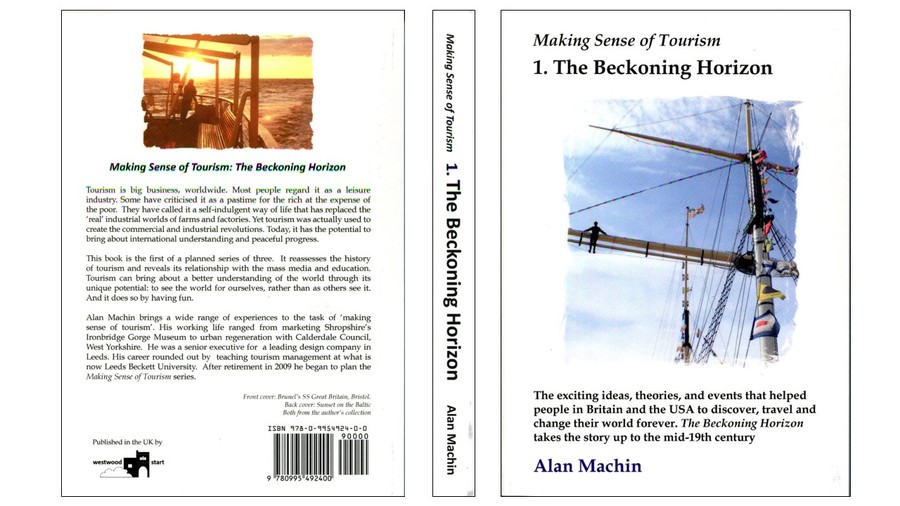
Click here to read the above page on 'The Beckoning Horizon'

Click here for brief notes About the Author

Click here for my personal Facebook page


Click here to send me an email
|